
If you’re a senior leader, CEO or Founder who finds yourself answering the same questions, solving the same problems, and being pulled into the same decisions week after week. I want to offer you a thought that might be uncomfortable.
Your team isn’t underperforming. They’re responding to you.
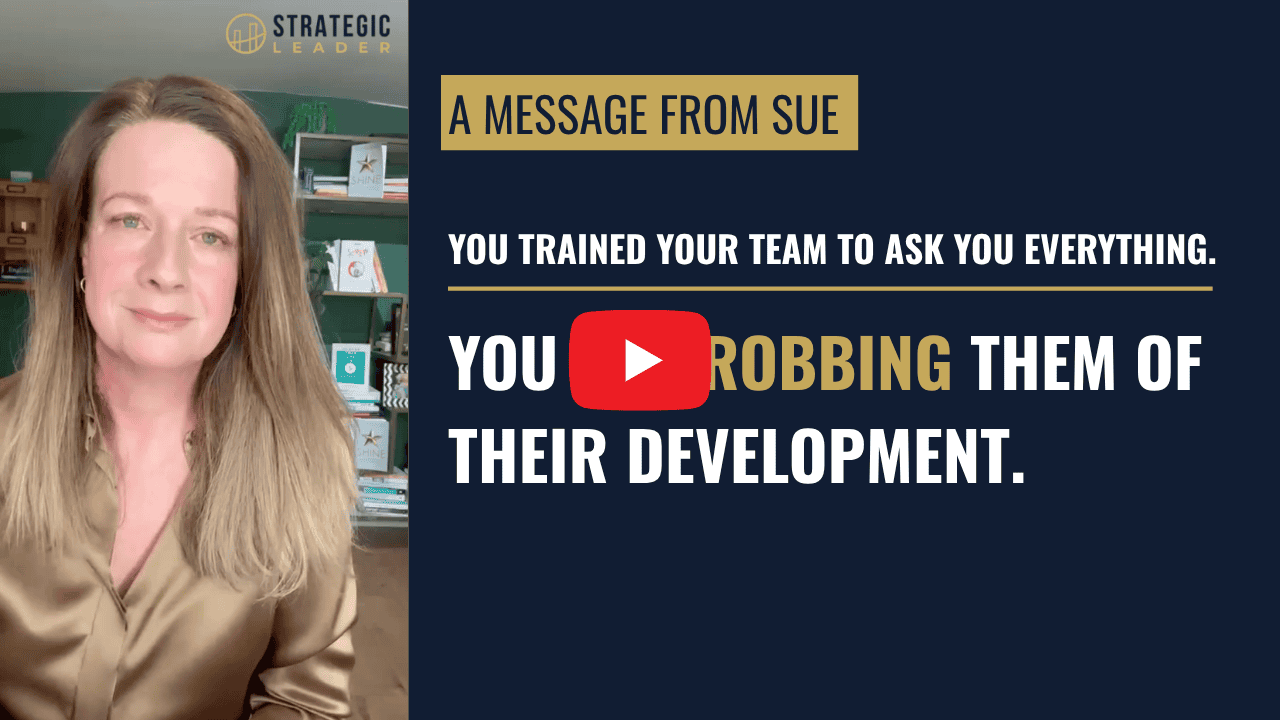
This is one of the most consistent patterns I see in my work as an executive coach in London and across the UK. Leaders who are genuinely brilliant – experienced, well-intentioned, highly capable – who have inadvertently trained their team to stop thinking.
Not because they’re bad leaders. Because they’re very good at doing. And that instinct to jump in, fix quickly, and move things along is exactly what’s getting in the way.
You Trained Them To. (Yes, Really.)
Every time you jumped in with the answer, every time you took the problem back, fixed it, moved it forward, you sent your team a message.
That message was: “Don’t bother working it out. Just ask.”
And they listened. Because that’s what people do when a pattern is consistent enough. They adapt to it.
The leader who corrects quickly gets a team that stops taking risks. The leader who tells more than they ask gets a team that waits to be told. The leader who is always available with answers gets a team that stops looking for their own.
Your team is not the problem. They are a mirror.
Now you’re the bottleneck. Exhausted, across everything, wondering why your team isn’t stepping up, when the honest answer is that you haven’t given them the space to.
The Part Nobody Talks About: You Are Robbing Them Of Their Development
Here’s what doesn’t get said enough.
When you jump in and solve a problem for someone on your team, you don’t just take on their workload. You take away their opportunity to grow.
The thinking they didn’t do. The decision they didn’t have to wrestle with. The moment of figuring-it-out – the struggle that would have made them sharper, more confident, more capable the next time a similar problem landed on their desk.
You are robbing them of their development.
Not maliciously. Not even consciously. But the impact is the same regardless of the intention.
A team that is never required to think for itself will never become the high-performing, high-agency team you need them to be. They remain dependent. They remain in their comfort zone. And they keep coming to you, because that’s the system you’ve built.
The leaders I work with who make this shift are often genuinely surprised by what their team is capable of, once they stop rescuing them.
The Shift: Hand The Thinking Back
The good news is that this is a leadership pattern, not a personality flaw. And patterns can be changed.
The shift isn’t about stepping back and hoping for the best. It’s about changing one small thing: what you do in the moment someone brings you a problem.
Instead of answering – pause.
Ask them what they think.
And then – this is the important bit – shut your mouth.
Hold the silence a beat longer than feels comfortable. Resist every instinct to fill it. Let them sit with the question. Because that moment of discomfort – that pause where they have to actually think – is exactly where the development happens.
It won’t feel natural at first. It will feel slower. It isn’t. What you’re doing in that moment is transferring ownership of the thinking back to the person who should have had it all along.
What To Do When They Say “I Don’t Know”
Some people – especially those who’ve been in a dependent dynamic for a while – will respond with “I don’t know” when you first start doing this.
That’s okay. Don’t accept it as a final answer. Stay curious. Ask more:
- What might you do?
- What’s your best guess?
- What do you need to move forward?
- What’s stopping you?
- What have you already tried?
- When did you first realise this was a problem – and what did you do about it then?
These aren’t trick questions. They’re the questions that hand the thinking back where it belongs, with the person who brought you the problem in the first place.
This approach mirrors what coaching psychologists call the GROW model – a framework that moves someone from problem to solution through questions rather than answers. You don’t need to be a trained coach to use it. You just need the discipline to ask rather than tell.
The goal isn’t to have all the answers. The goal is to make your team think.
Make Them Accountable – And Stop Chasing
Once they’ve worked through the problem – with your questions, not your answers – don’t let the conversation end without clarity on what happens next.
Ask: “So what are you going to do, and by when?”
And here’s the accountability piece that most leaders get backwards. They check in on their team. The team waits to be chased. This keeps the ownership firmly with the leader, which is exactly the problem you’re trying to fix.
Flip it.
Make it their responsibility to come back to you. “Let me know how you get on” not “I’ll follow up with you on Friday.” That one shift in language changes who owns the outcome.
When your team knows they’re accountable for the next step, and that they need to report back, not the other way around, something shifts. They take more ownership. They think more carefully. And they start to become the team you always wanted them to be.
What This Looks Like Over Time
It feels slower at first. It isn’t.
Within a few weeks of consistently asking rather than answering, the questions reduce. The quality of thinking goes up. The team gets stronger. And you start getting your time and your headspace back.
In fact, the leaders I work with who make this shift, alongside the other changes we tackle together, typically reclaim 10 to 25 hours a week. Yes, really. Hours that were being swallowed by other people’s problems, other people’s decisions, other people’s thinking. Hours that belong to strategy, to clarity, to actually leading at the level their role demands.
Senior leaders I work with as an executive coach – both in London and in global organisations across the UK – tell me this is one of the most significant shifts they make. Not because it’s complicated. But because it requires them to resist an instinct that has served them well for most of their career.
The instinct to fix.
You don’t need a more capable team.
You need to stop being the reason they aren’t using the capability they already have.
That’s the shift. And it starts with one conversation done differently.
Ready To Lead Differently?
I’m Sue Belton — an award-winning executive and leadership coach working with CEOs, Founders, MDs, VPs and senior leaders in global organisations across London and the UK. I’ve spent over 17 years helping high-performing leaders step out of operational overload and into the strategic leadership their role actually demands.
I’m the international bestselling author of Screw Meditation! and Change Your Life in 5, and the creator of the Strategic Leader Programme.
If this resonated and you’re ready to do something about it, I’d love to have a conversation. Explore my Strategic Leader Programme, or connect with me on LinkedIn and say hello.